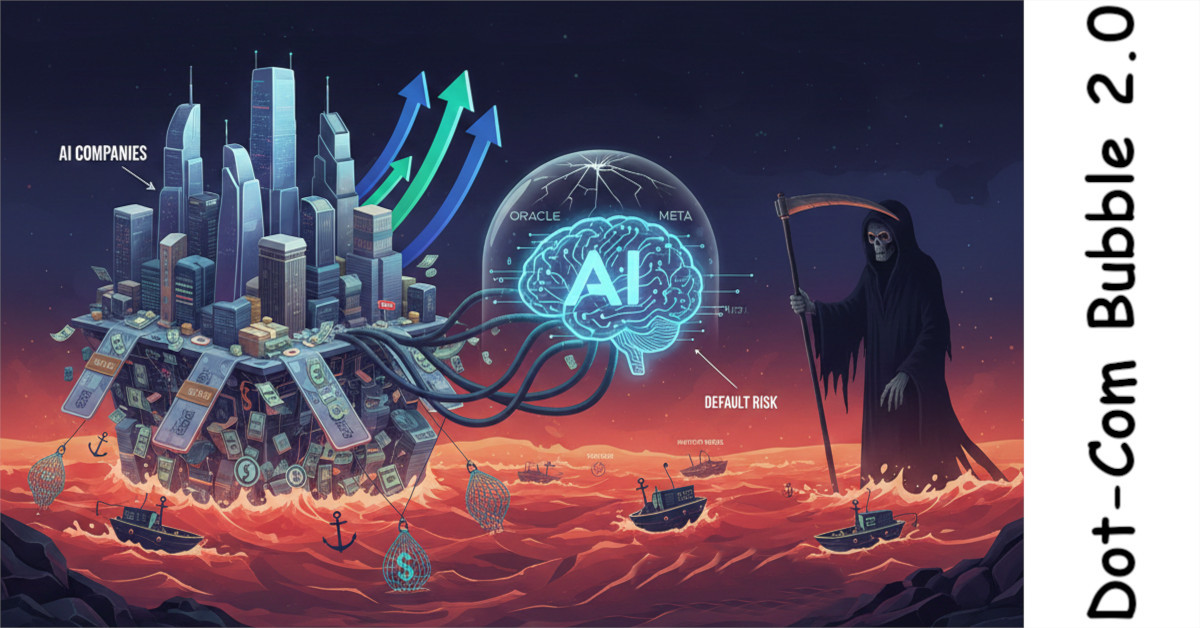

The rise in Artificial Intelligence is driven by a huge increase in corporate borrowing. The market is becoming more divided: AI companies` stock prices are rising sky-high , while the credit market is growing tense, with investors rushing to protect themselves against a possible “AI debt crash”.
AI Debt Structure
The current AI race requires enormous upfront spending to build the infrastructure needed for advanced AI systems. Most of this money is going toward building massive data centers and buying expensive hardware, like Nvidia GPUs, which are in high demand. Experts estimate that the total debt needed to fund this AI infrastructure could reach around $1.5 trillion by 2030.
This is a major change for big tech companies. In the past, the largest tech firms, "Magnificent Seven", were praised for being asset-light, meaning they didn’t need to spend heavily on physical infrastructure and generated strong cash flow from software.
Now, they are becoming asset-heavy, investing a much larger portion of their revenue into physical assets. For example, Meta, Microsoft, and Alphabet plan to spend between 21% and 35% of their revenue on capital expenditures, which is even higher than the typical spending in the utility sector.
- Where the Debt Is Being Issued
Oracle, for example, has raised $18 billion in debt and signed big contracts with AI companies. This has caused investor concern, with its credit default swap (CDS) spreads, the cost of insuring against default, reaching their highest levels since 2009. This shows that investors see more risk in Oracle’s debt.
Meta also issued $30 billion in bonds to fund its AI projects. After this, trading in CDS for Meta’s debt increased, showing similar investor concern.
Overall, companies tied to AI now make up about 14% of the investment grade corporate bond market. In some analyses, they even surpass US banks in size within the bond index. This shows how AI investments are changing the financial markets.
The Main Risk
Investors are worried because there’s a big risk that AI spending might not quickly turn into steady revenue that can pay off all the debt.
- Slow Returns: AI projects take much longer to show results compared to typical tech projects. Reports suggest that around 95% of generative AI projects aren’t yet delivering clear business value. The payback period for AI projects is usually 2-4 years, while traditional tech investments often pay off in 7 - 12 months.
- High Operating Costs: AI models, especially llms, have significant costs every time they’re used. This makes it harder to scale them profitably.
- Competitive Pressure: Big tech companies are in a kind of trap. If they don’t invest heavily in AI, they risk falling behind competitors. But when everyone spends aggressively, it can drive down profits across the industry, creating a “race to the bottom” in prices for computing power.
Investors are protecting themselves using Credit Default Swaps (CDS) . It`s a type of insurance in case a company can’t repay its debt.
Professional investors see the debt as riskier than the stock prices suggest, and they demand higher returns to hold it.
Companies are also using private loans and more complex financial products, like asset-backed securities tied to data center revenue. This also adds risks that are harder to see and understand.
The current AI boom has some similarities to past financial bubbles, like the dot-com crash in 2000. Back then, companies built huge infrastructure, fiber-optic networks, without enough demand, which led to widespread debt defaults among telecom providers.
But the situation today is a bit different
- The biggest AI investors - Meta, Alphabet, and Microsoft, still have strong finances and large cash flows from their core businesses, which gives them a cushion against potential problems.
- The risk is mostly confined to the tech sector and its infrastructure providers, not spread across the entire financial system as in the 2008 financial crisis.
The smart move is to balance exposure, meaning - enjoy the upside of AI equity, but protect against a potential correction if, more likely when, these highly leveraged companies fail to generate profits fast enough.